
Making Sounds. How We Produce Speech
On articulatory phonetics

Meowza hooman,
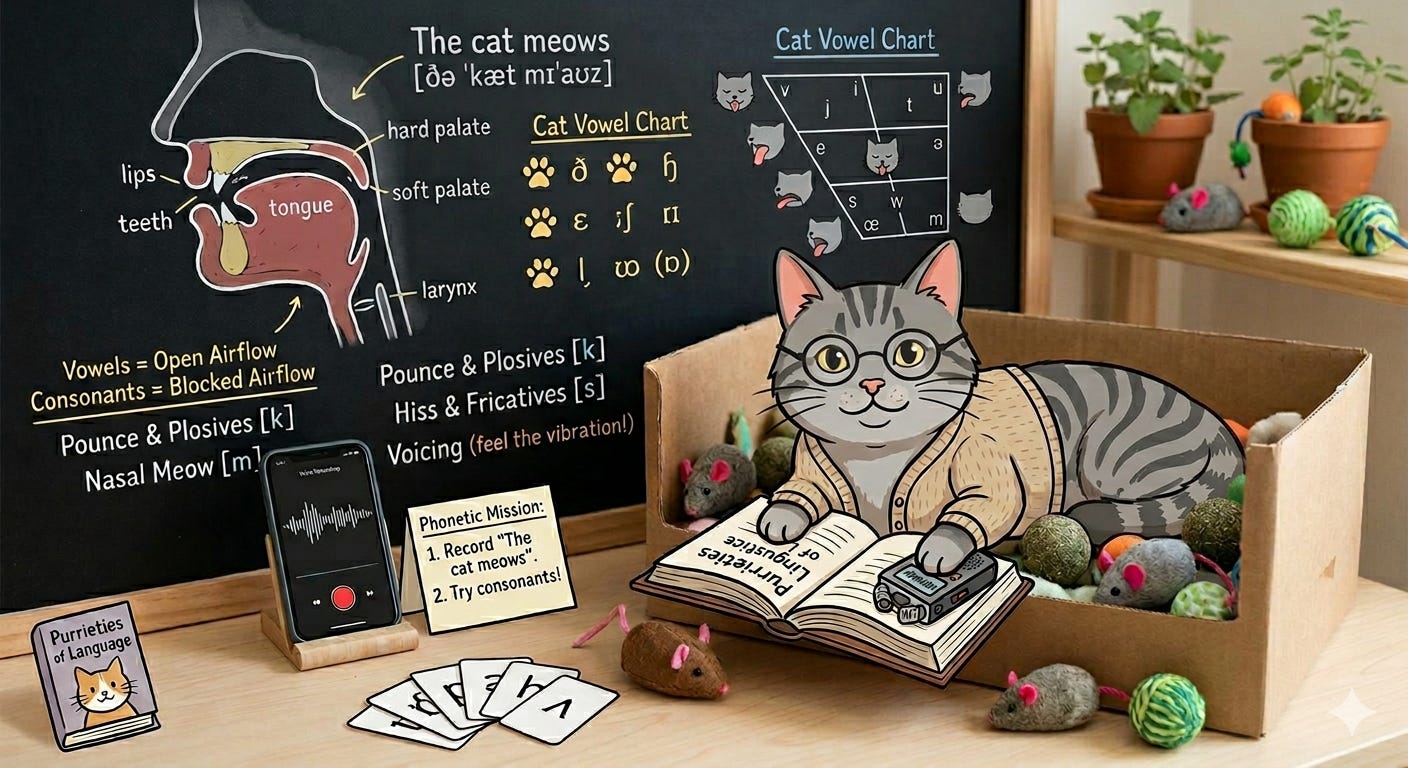
Say something and pay close attention to your lips, teeth, tongue, hard palate, soft palate, larynx, and the likes. You’ll notice that you use your vocal tract, i.e. the various physiological parts from the neck upwards, to produce speech sounds. How’s that important you may ask. Well, linguistics tells you.
Now get comfy in your cardboard box 📦 and take your catnip 🌿 out. It’s time for the fortnightly newsletter, which is all about speech production.
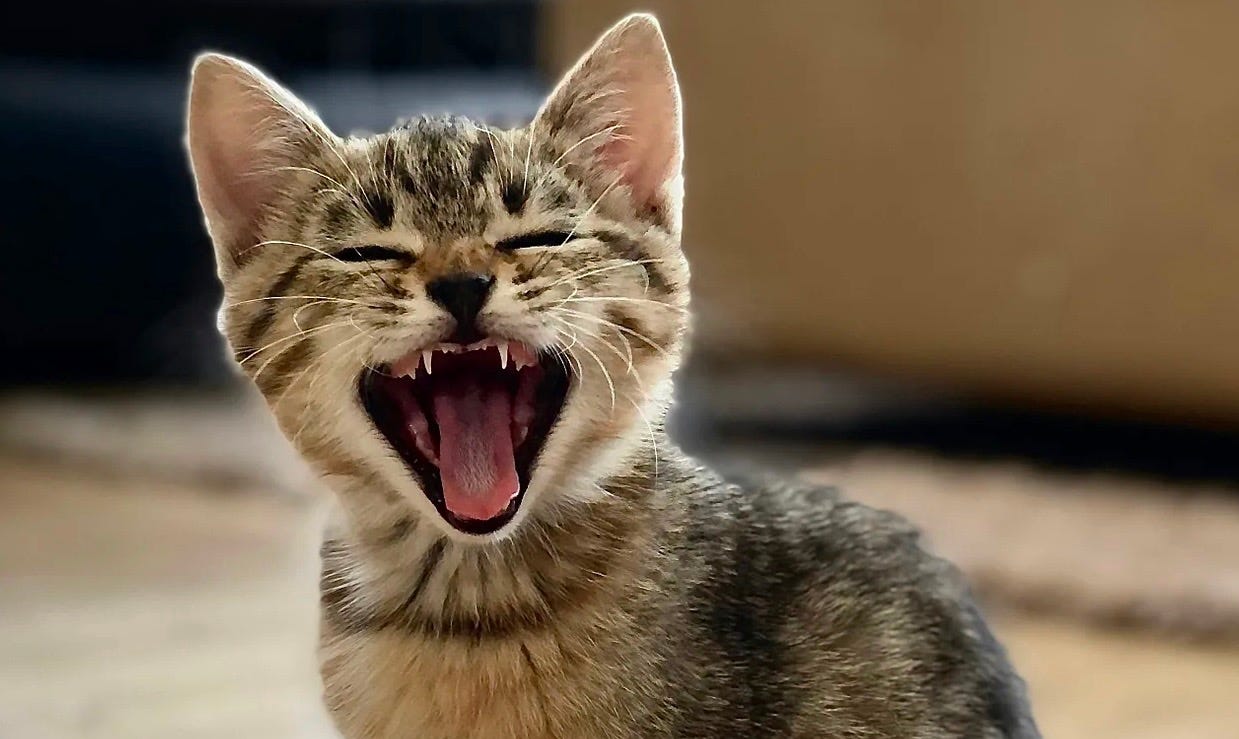
Let's take the following sentence as example: The cat meows. In IPA symbols, this looks like [ðə ˈkæt mɪˈaʊz/]. This sentence consists of vowels and consonants.
Just in case you are asking about what vowels and consonants are: When you produce a vowel, you do not really hinder the airflow in any way in your vocal tract, whereas when you produce a consonant, you form some sort of stricture there.
Imagine you are at the doctor’s and say a long “ah” ([ɑ:]) . Thank you. And now say “k” ([k]) as if you are coughing up a furball and notice what happens in the vocal tract. In the case of [ɑ:], nothing, and in the case of [k], you fully block the vocal tract and then open it suddenly with a kind of little explosion: [k].
When you slowly say the full sentence [ðə ˈkæt mɪˈaʊz] and pay attention to your vocal tract, you can feel the differences between vowels and consonants.
Articulatory phonetics is all about how we make the sounds we use when we talk. It looks at how our mouth, tongue, lips, and jaw move to shape the airflow coming out. It classifies sounds by whether our vocal cords vibrate, where in the mouth the sound is made, and how the airflow is blocked or shaped.
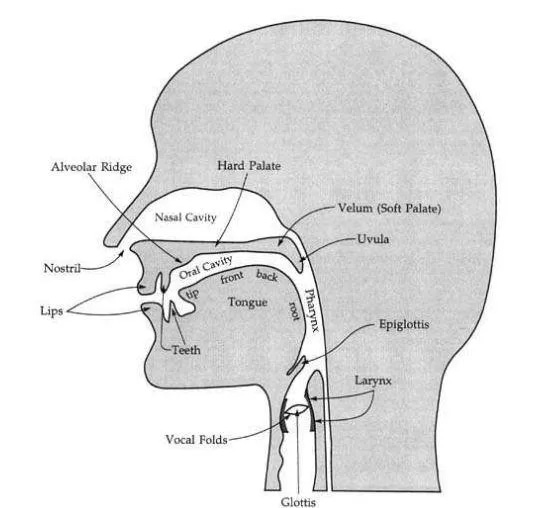
In articulatory phonetics, we classify the sounds based on voicing, place of articulation, and manner of articulation.
What we need to do now is to describe the sounds that we produce. One category is voicing: sounds are either voiced or unvoiced depending on whether our vocal cords vibrate or not. That sounds complicated but is actually quite easy: Put your hand lightly on your larynx and say mmmmmeow [mɪˈaʊ]. You should feel a vibration. And now say hissssss [hɪs]. Now there is no vibration.
Vowels are always voiced, consonants can be voiced or unvoiced.
As for the place of articulation, let's go back to our example [ðə ˈkæt mɪˈaʊz] and say it very slowly sound per sound. You’ll notice that your lips open and close and your tongue moves. [k] is at the back and [t] involves your tongue and the alveolar ridge behind your teeth.
The [ɪˈaʊ] in meow aka Vowels
The IPA chart shows how and where we produce vowels.
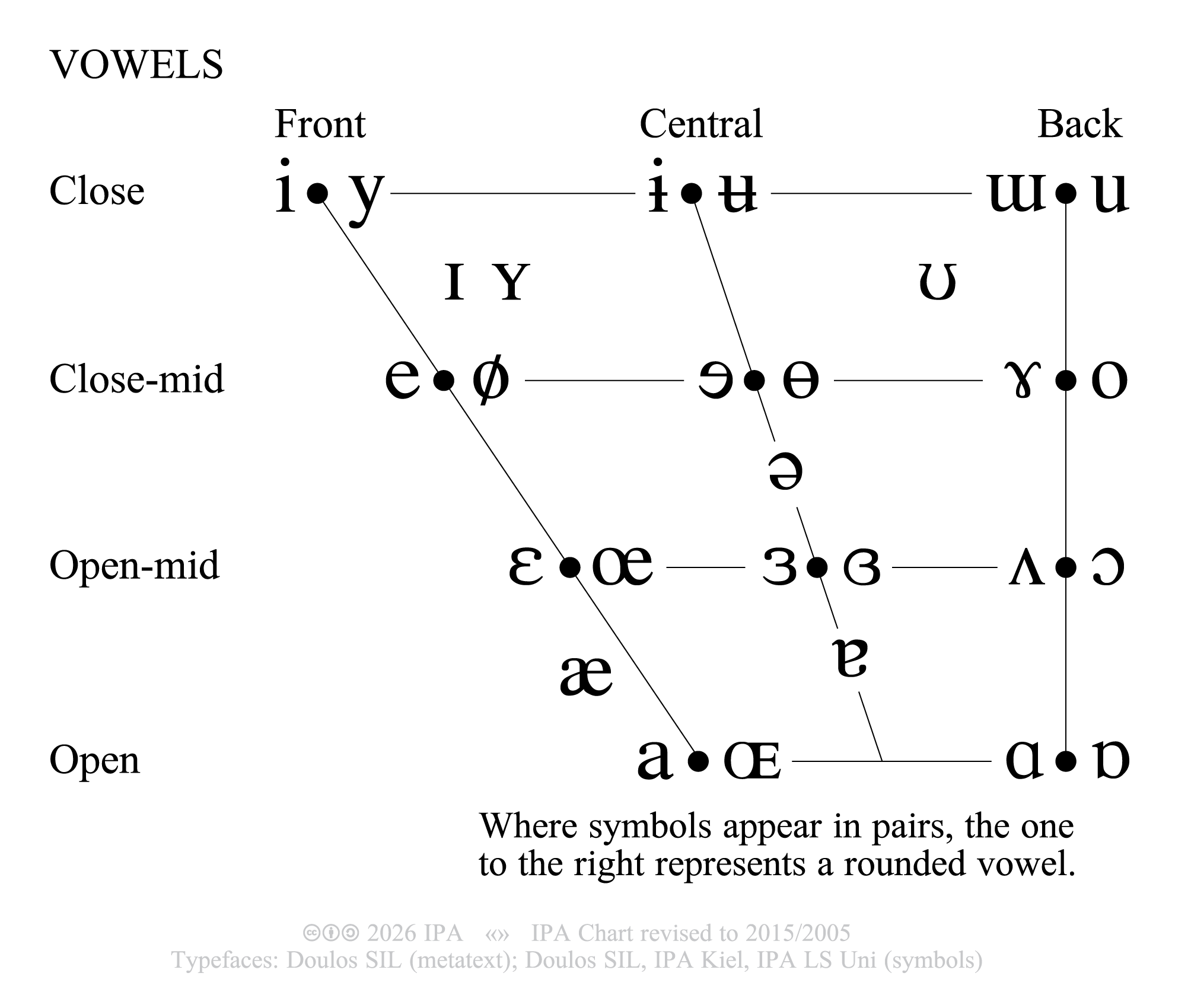
The vowel chart (also called vowel quadrilateral) is a stylised cross-section of your mouth from the side. When you say the vowels and pay attention to where in the mouth you produce it, the labels make sense. The labels are about tongue height and front/backness. And pay attention to the lips: Do you round them or spread them?
Say purr, paw, and pair. Again you can feel the differences. We describe the vowels in terms of their tongue height and advancement as well as lip rounding. The [i:] vowel in meow is a long close unrounded front vowel.
In addition to the monophthongs, i.e. stable vowels, there are also diphthongs, i.e. where the tongue glides from one vowel to another. Let's look at meow again: first we have the long [i:] vowel and then the diphthong [aʊ]. There is quite some tongue movement involved.
The [m] in meow aka Consonants
The chart shows where and how we pronounce the consonants.
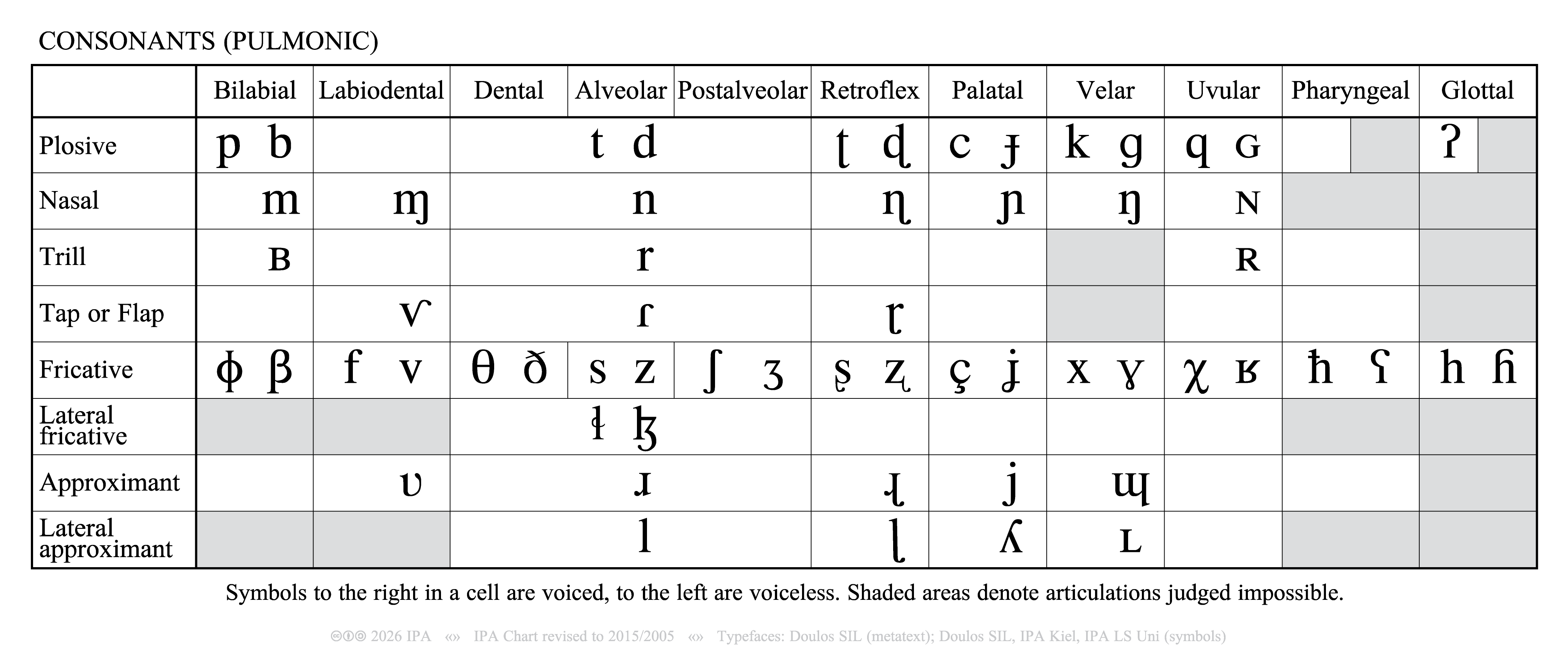
Apart from the label “voiced/voiceless”, consonants have the labels “place of articulation” and “manner of articulation”.
The place refers to where in the mouth we manipulate the airflow, i.e which articulators are involved: lips, teeth, hard palate, soft palate of further back. Say the [m] as in meow and you feel your lips, say cat and you use your velum for the [k] sound and the back of your teeth for the [t] sound.
And manner depends on what we do with the airflow: fully block it or partly block it, let it flow out through a narrow opening and so on.
Plosives (Stops): Like the [k] in cat. You build up air pressure and then explosion! and you release it. It’s the linguistic equivalent of a pounce.
Fricatives: Like the [s] in hiss. You bring your articulators so close together that the air gets turbulent and noisy. It’s the “static on the radio” of speech.
Nasals: Like the [m] in meow. You lower your soft palate (the velum) and let the air escape through your nose. Pinch your nose, try to say meow and you feel your nostrils straining against your fingers.
All together now — The cat meows [ðə ˈkæt mɪˈaʊz]
In real speech, we don’t say sounds in isolation. We already start preparing for the next sound while still finishing the current sound, which means that the current sound affects the next sound: The nasal [m] may make the following vowel [i:] slightly nasalised. This is called coarticulation.
By the way, cats, too, are able to pronounce vowels and consonants. And there is a chart for them, too: Phonetician Susanne Schötz has drawn up a cat vowel chart. Check it out on Cat Vowel Chart to see which vowels a cat can pronounce.
Your phonetic mission
Record yourself saying “The cat meows” and listen for the vowels and consonants.
Try to pronounce the consonants using the IPA chart.
Just in case you want to read up on the IPA, check out this post:


I love language and I love cats 😻. And I am a linguist with a PhD in dialectology and the author of the book Purrieties of Language: How We Talk about Cats Online. So why not come along with me and enjoy linguistics with cats 😸.
One problem with your meow is that M is actually in between a vowel and consonant, I know I'm being a smart alec, but I have enough linguistics in my undergraduate that the only thing that stops an M from being a vowel is your lips.