
Writing in Sounds
Learn a new writing system with IPA

/mɪ'aʊzə 'hjuːmən/,
This time the greeting comes in phonetic transcription. Meowza hooman is /mɪ'aʊzə 'hjuːmən/ in IPA symbols. IPA stands for International Phonetic Alphabet, whose symbols are used in linguistics to write down how sounds are pronounced in a language.
So get comfy in your cardboard box 📦 and take your catnip 🌿 out. It’s time for the fortnightly newsletter, which is all about phonetic symbols.
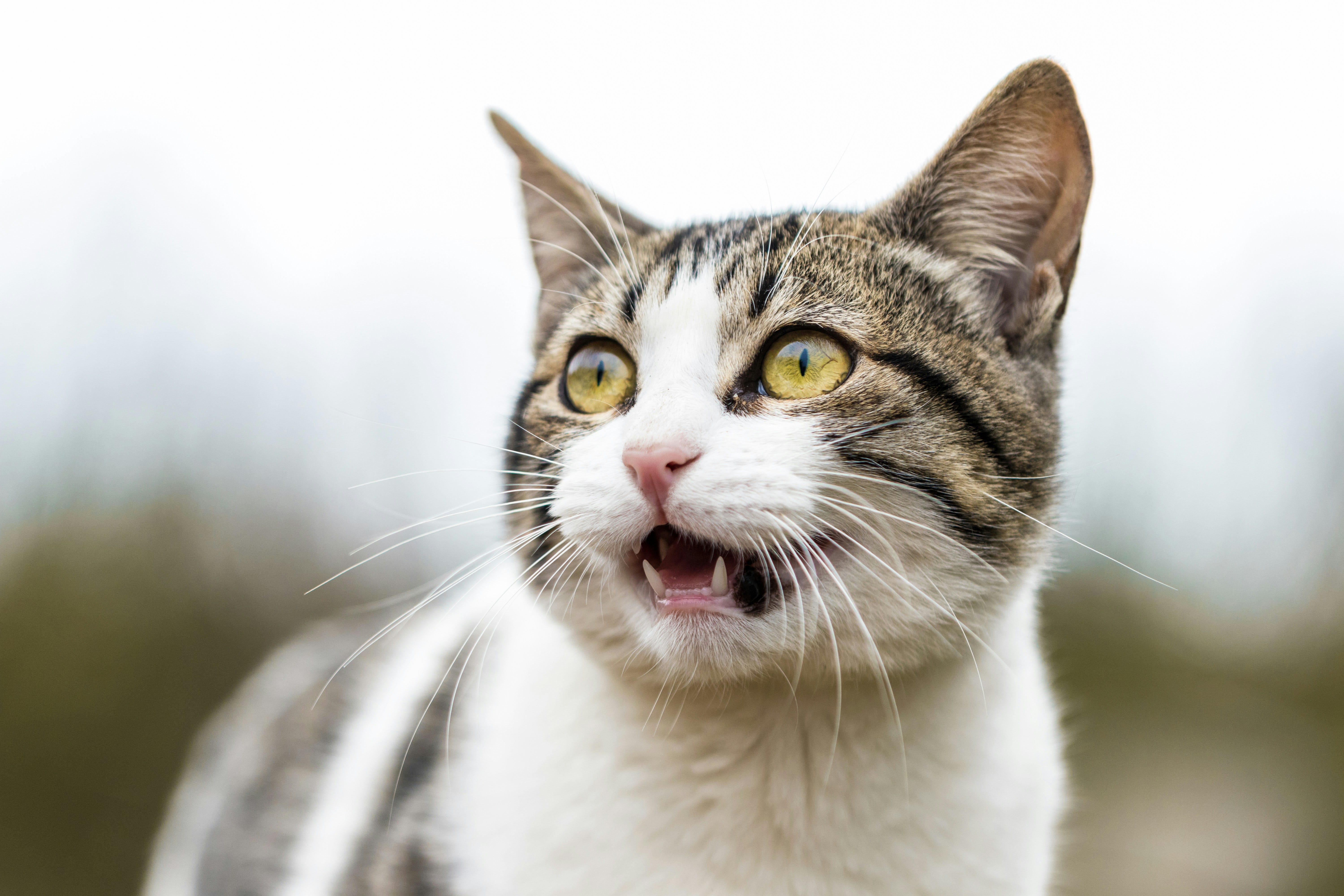
Phonetic symbols are like a new alphabet to learn — for each sound you have a specific symbol. The phonetic alphabet is similar to the Roman alphabet and it is used a lot in dictionaries. Phonetic symbols mean that you are writing in the sounds you hear. By doing so, you can ignore regular spelling, as in cat and kitten, which both start with the same sound, /k/.
Cat and kitten are /kæt/ and /ˈkɪtən/ in IPA symbols. The initial sound is the same: /k/
In the image below, you see the International Phonetic Alphabet (IPA) in all its glory: For every sound possible in human language, there is a symbol, which means that there is an alphabet for all the languages in the world.
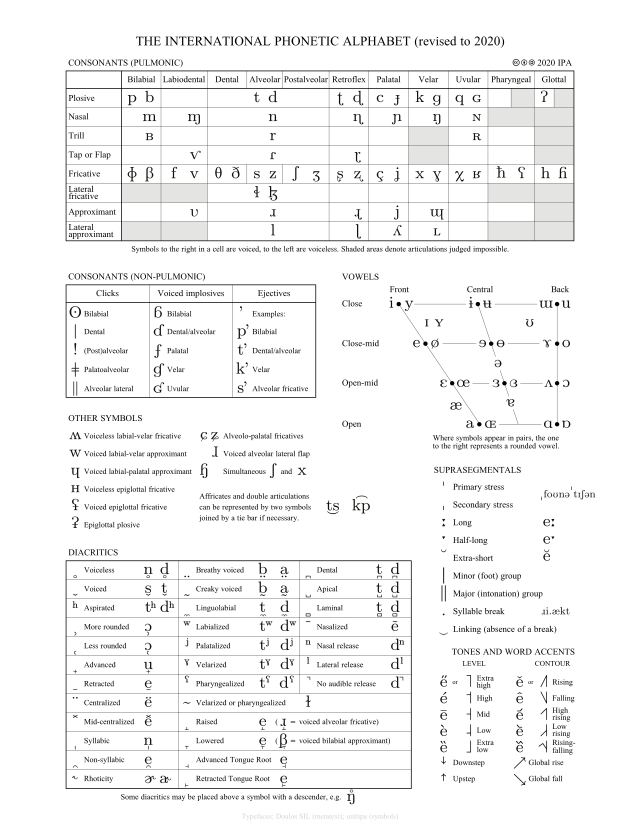
Altogether, IPA consists of more than 100 letters that you can use for the various sounds. For English, you only need 44 of them as 44 is the number of phonemes RP (Received Pronunciation, i.e. the standard accent of English in the UK) has. You can check out the 44 symbols (phonemes) for consonants and vowels here in this image:
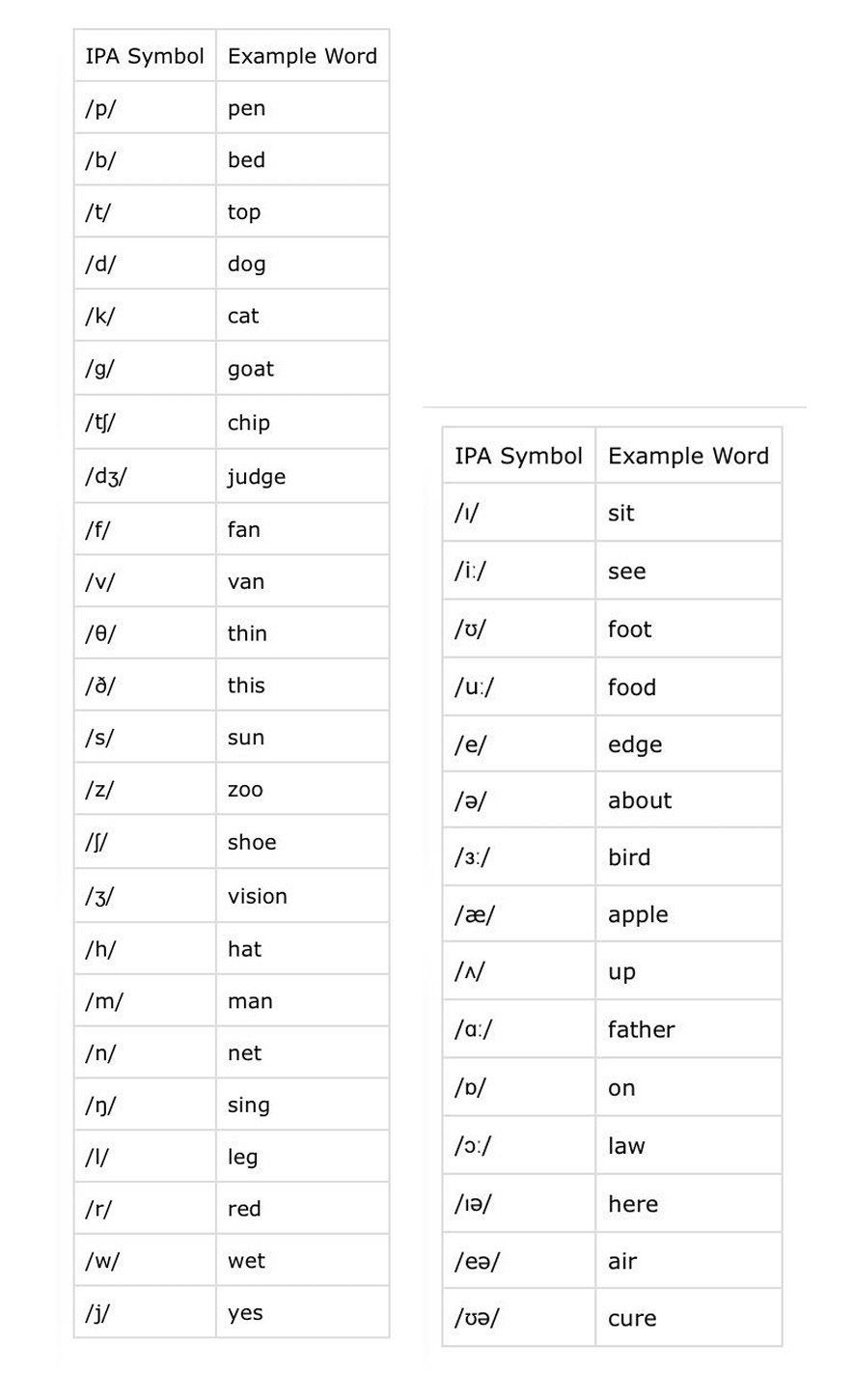
Created by me
By the way, a phoneme is the smallest basic sound unit of a language, making a word different from another: by changing /k/ to /h/, cat becomes different from hat, for example. In other words, cat and hat are a so-called minimal pair.
The phonetic symbols are usually set off by using slashes (/ˈslæʃɪz/) or square brackets ([skwɛː ‘bɹækɪts]). Which notations I use — whether it’s the slashes or the square brackets - depends on how I look at the sounds: in their broad transcription or in their narrow transcription.
The broad transcription is something we find in dictionaries. The transcription of the word cat is /kæt/, with the voiceless velar plosive consonant /k/, the short open unrounded vowel /æ/, and the voiceless alveolar plosive consonant /t/. This description is part of articulatory phonetics, the study of how we actually produce the sounds. We’ll look at articulatory phonetics in one of the next issues of Purrspectives in Language.
The narrow transcriptions looks at the finer points of pronunciation and includes features like aspiration. So /kæt/ becomes [khæt], which is how we actually pronounce cat in RP. In South Wales, /kæt/ is pronounced [kat], which shows us that there is less aspiration of the consonants and a different vowel sound. /kæt/ might also be [kæʔ], with [ʔ] being the symbol for the glottal stop. In linguistics we talk about allophones.
Allophones are the different ways a phoneme can be pronounced. For example, the phoneme /t/ in cat can sound like [t] or [ʔ]. The way we pronounce a phoneme depends on the surrounding sounds as well as on our accent or the context we are in.
Transcribing words in phonetic symbols takes a bit of practice: First, you need to learn the symbols that you use for a particular language — in other words, you need to know the phonemes of that language — and second, you need to train your ear so that you actually hear the difference between sounds, especially if you are working with a language that is not your native language. And third, you have to ignore the orthographic spelling of the word you are transcribing.
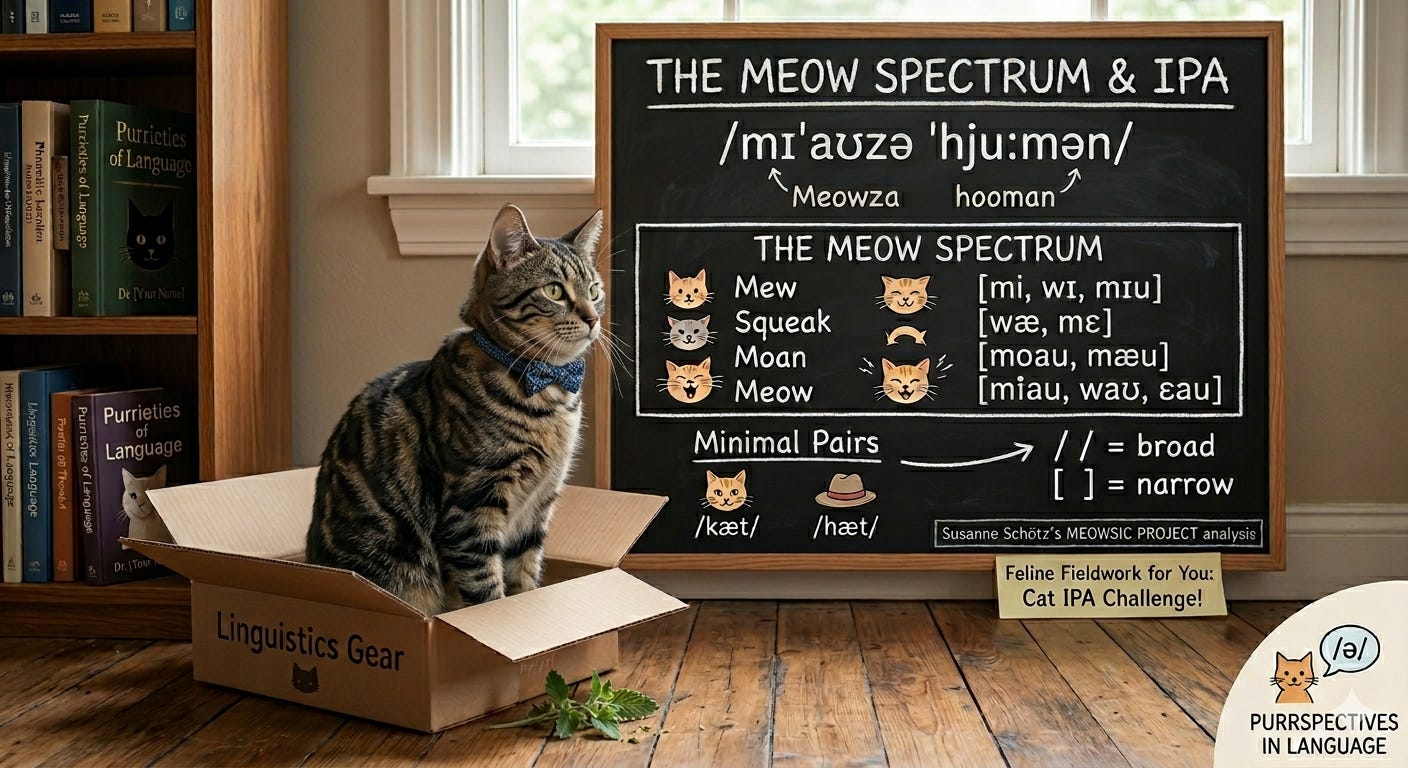
Meowza hooman is /mɪ'aʊzə 'hjuːmən/
The Meow Spectrum:
The word meow is a so-called onomatopoeic word, which means that the word itself imitates the cat’s meow. Yet, how we spell the meow depends on the language that we speak: meow, miaou, miau, nyan (English, French, German, Japanese). If we transcribe the words, we have differences in pronunciation, which can be shown in phonetic symbols:
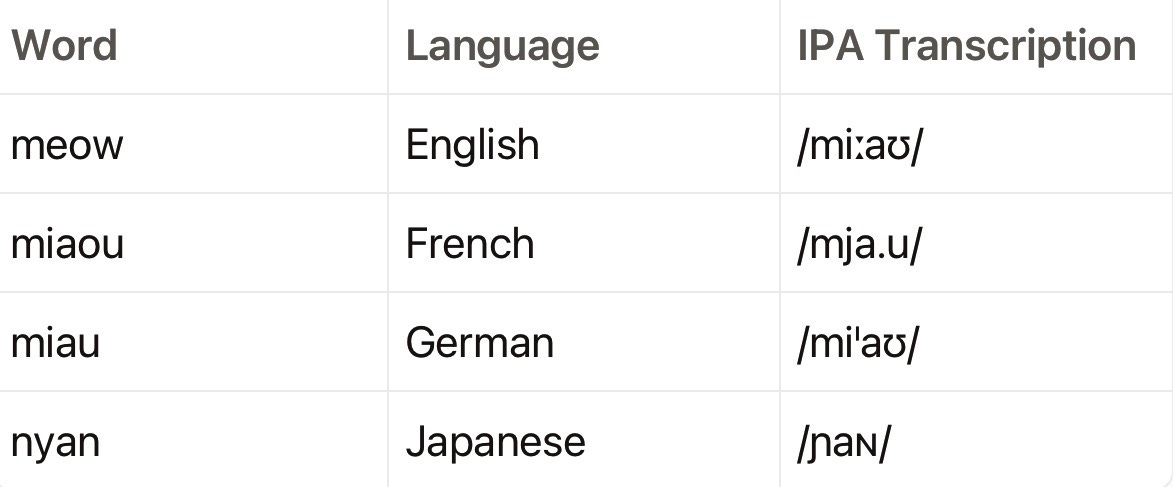
The phonetic symbols show us the differences in the vowel and consonant sounds. For example Japanese uses /ɲ/, a nasal consonant sound that does not exist in English, and French has a slightly different vowel sound.
IPA symbols usually represent human sounds but have also been used for cats. In her Meowsic Project, Swedish phonetician Susanne Schötz has analysed real cat sounds:
A mew is a very high-pitched meow, often with [i], [ɪ], or [e] vowels, and sometimes followed by a [u]. Kittens mew to solicit attention from their mother, and adult cats may mew when they are anxious or in distress and need the help of their human caretakers. A mew often sounds like [mi], [wi] or [miu].
Mew [mi], [wɪ] or [mɪu] Squeak [wæ] or [mɛ] Moan [moau] or [mæu] Meow [miau] or [waʊ] or [ɛau]
Feline Fieldwork for You
Cat IPA Challenge #1: How would you transcribe your cat’s sounds? Cats meow, purr, hiss, and growl.
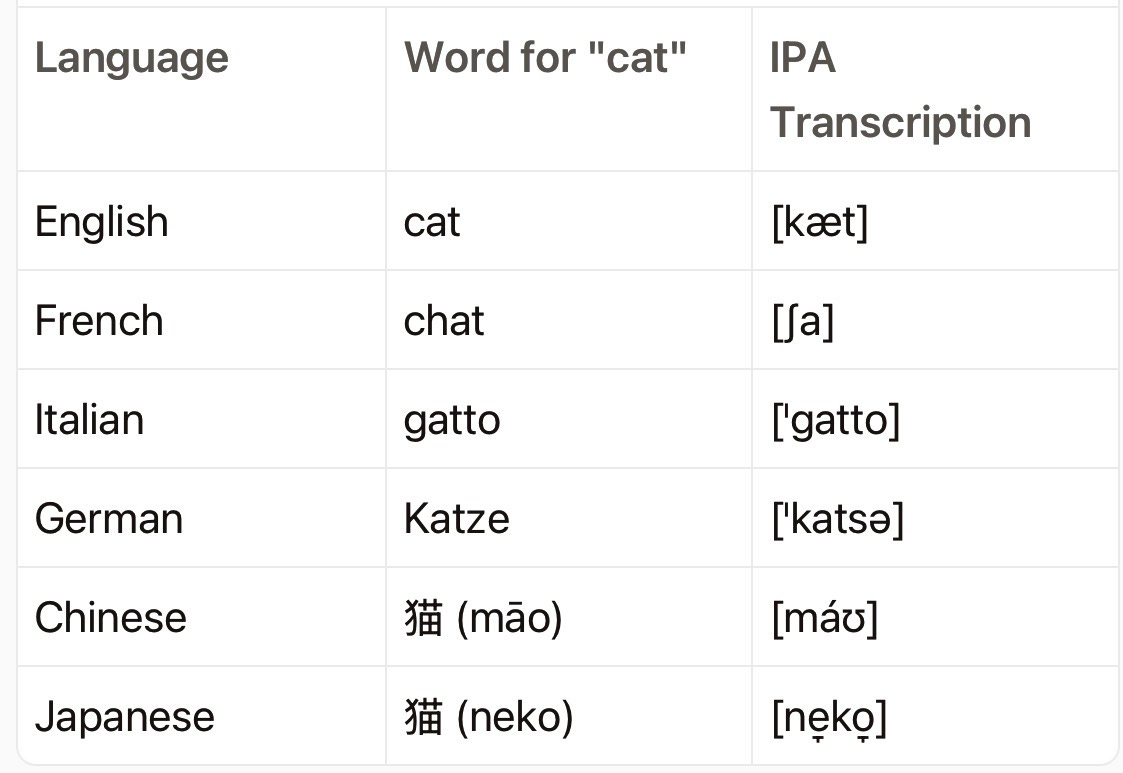
Cat IPA Challenge #2: If you want to try something less advanced, check out how you would say the word cat in various languages. Read the phonetic symbols for the words for 🐈⬛ in English, French, Italian, German, Chinese, Japanese, …
I love language and I love cats 😻. And I am a linguist with a PhD in dialectology and the author of the book Purrieties of Language: How We Talk about Cats Online. So why not come along with me and enjoy linguistics with cats 😸.
Sorry I keep commenting, but I'm really into this and now I have questions! with θ and ð, which parts of the words "thin" and "this" are being indicated? and how do I do the sound of the "i" in "time?"
[trænskrɪpʃən ɪs fən!] Do you have all of the symbols memorized, Edith? In other words can you do this off the top of your head without looking?