
[miau]
What our accent says about our identity

Meowza hooman,
How we pronounce the word meow depends on where we are from, i.e. the accent that we have. We all have an accent because that is how language works. And when we pretend to be cats online, that’s what we use to show that we are cats.
So get comfy in your cardboard box 📦 and get your catnip 🌿 out. It’s time for this month’s newsletter, which is all about accents, cats, and identity.
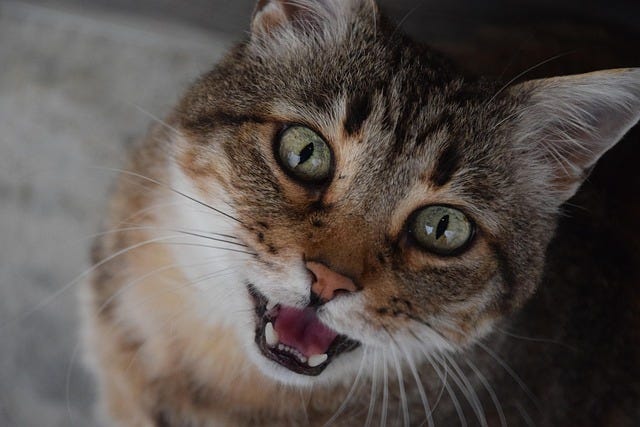
Linguistically speaking, a dialect differs from another in terms of accent, grammar, and vocabulary, and we all speak a dialect. Even if we think we do not have an accent, we do. Our accent may be closer to the standard, which usually has overt prestige and in which case we think that we do not have an accent, or it may broader, simply indicating that we are from a different place than the others around us.
And the fact that we all have an accent allows others to judge where we come from regionally as well as socially. It is neither good nor bad that we signal to others where we are from. Our accent is part of us, and with it our conversational partners get a feel for us.
Accents can have overt and covert prestige. With our accent, we are signalling whether we are aiming for the standard or showing our street credibility within a specific group. A well-placed purrfect does wonders for you in the cat communities but would do you no good in a professional environment.
Our accent is also not a fixed entity. It changes depending on the situation we find ourselves in or on the person we are speaking with. Again that is neither a good or a bad thing. It's just something that happens. It's a sign of our ability to function in various situations. We change our accent consciously or subconsciously, we, being copycats, pick up linguistic habits from people around us, and as a consequence we have quite a range at our disposal.
This range allows us to choose a particular accent in certain situations. We might speak more standard accent in formal situations and less standard in relaxed situations. Linguistics refers to this as code-switching. We have learned which register — formal or informal — is appropriate in which situations and we use a particular accent accordingly.
The way we speak is tied up with our identity, which means that accent is identity. Now because we have a range of linguistic habits available, we can perform a particular identity. We do that consciously or subconsciously.
And this is where we put the cats into play. Online in our cat communities, we want others to know that we are cat lovers or even pretend to be cats. With a change in accent, we change our identities and we perform (purrform) our feline identity. We use catified language as an outward signal of us being cats. This cat accent can include meowlogisms, like pawsome, different grammar, such as If I fits, I sits, and different vocabulary, like floof.
Just before you go, check out what catspeak words cat lovers like you have come up with in the Catspeak Selection.
Catspeak Selection
Catlympic event
Mozart’s Meowgic Flute
dear furriends
Meowdy, partner
Meowlicious Meownday
St Pawtrick’s Day
Tabbyloid and mewsletter
purrsistance
paws-port
C’Lawréal
Good Mousekeeping
Catmopolitan
A couple of our cats have the quietest purrs I ever heard!
We say they -Wispurrr to us!
I do have two other cats that communicate by making (I'm not sure they're vocalisations) by keeping there mouths closed. They start at a low pitch and slowly go higher up in a range. But some are short and some are longer!
I equate it to playing Marco purrrlow!
Always so sweet! 🐈⬛